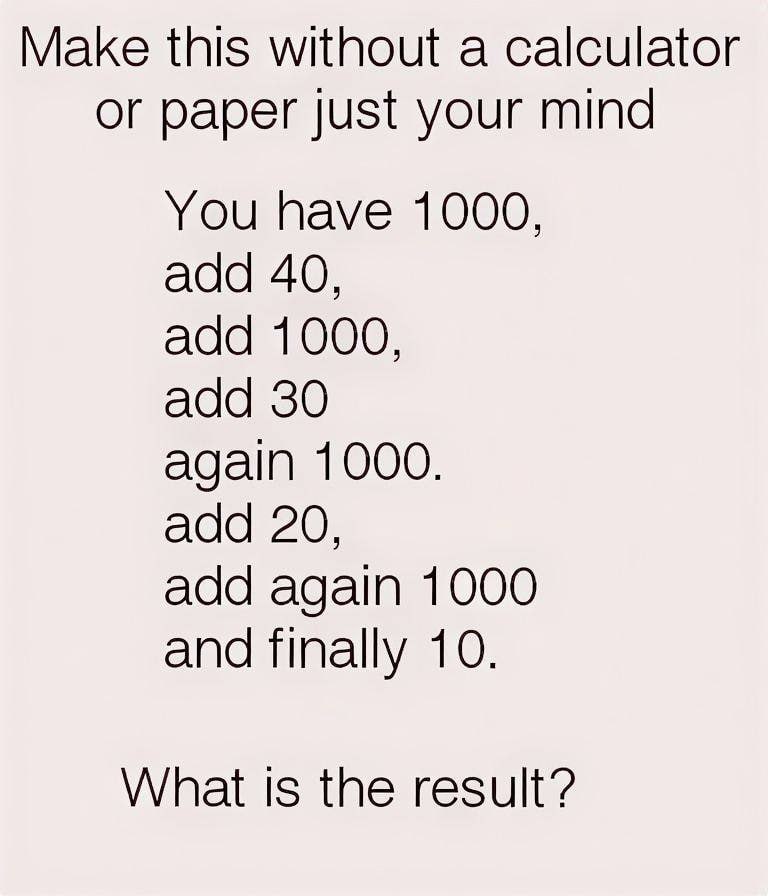
You have 1,000.
Add 40.
Add another 1,000.
Add 30.
Add another 1,000.
Add 20.
Add another 1,000.
Finally, add 10.
What result did you get?
Many people quickly answer 5,000. If that was your answer, you're not alone. This classic mental math puzzle tricks the brain into rounding and rushing through the additions.
Let's check the numbers carefully:
1,000 + 40 = 1,040
1,040 + 1,000 = 2,040
2,040 + 30 = 2,070
2,070 + 1,000 = 3,070
3,070 + 20 = 3,090
3,090 + 1,000 = 4,090
4,090 + 10 = 4,100
The correct answer is 4,100, not 5,000.
Why do so many people get it wrong?
The brain tends to focus on the repeated thousands and unconsciously expects the final result to be a round number. The sequence is designed to encourage fast thinking rather than careful calculation.
This simple puzzle is a great reminder that our minds often rely on shortcuts, and those shortcuts can sometimes lead us to surprisingly wrong answers.