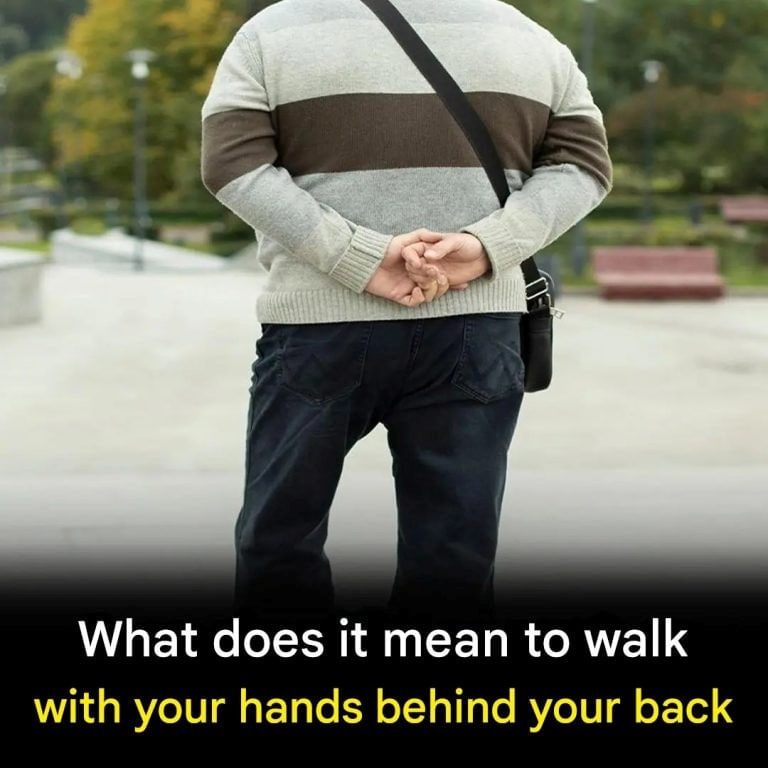
Walking with your hands behind your back is often seen as a “natural” posture, but in psychology and body language research, it can have several possible meanings depending on context, culture, and situation. There is no single fixed interpretation.
1. A sign of calm thinking and mental processing
In many observational studies of posture, walking with hands behind the back is linked to:
- Deep thinking or concentration
- Slower, more reflective walking
- Reduced external stimulation (less gesturing = more internal focus)
People often adopt this posture when they are absorbed in thought, similar to pacing while solving a problem.
2. A posture of confidence or authority
In certain contexts (especially among older adults, teachers, military officers, or leaders), it can signal:
- Self-control
- Composure
- A sense of authority or “I am not rushed”
By keeping the front of the body open, it may also unconsciously signal non-aggression and confidence.
3. A “resting” posture for the arms
From a biomechanics perspective, it is simply a comfortable position:
- Reduces tension in the shoulders
- Helps balance the body while walking slowly
- Often used when there is no need to carry or gesture
So sometimes it has no psychological meaning at all—just comfort.
4. Emotional state: relaxed, but not always expressive
Compared to arms swinging or folded arms:
- Hands behind the back = low emotional expression
- Often seen in neutral or calm states
- Can indicate emotional restraint (not showing feelings openly)
However, this does NOT reliably indicate sadness, confidence, or dominance on its own.
5. Important scientific caution
Modern psychology of body language emphasizes that:
- No single gesture has a universal meaning
- Interpretation depends on culture, personality, and situation
- Reliable conclusions require clusters of behaviors, not one signal
So, walking with hands behind the back is not a “code” that reveals hidden thoughts, but a neutral posture that can reflect different mental states.
Conclusion
This walking style can suggest calmness, reflection, confidence, or simply comfort—but it does not reveal a fixed psychological truth. Like most body language, its meaning is context-dependent rather than diagnostic.